
Every collector remembers the first time they turned to the copyright page of a book and wondered: is this actually a first edition? The words “first edition” get used loosely by sellers, and the difference between a true first edition, first printing and a later reprint can be the difference between a book worth a few pounds and one worth hundreds. Here’s how to tell them apart, the same checks we use for every book we list at Doodled Books.
First edition vs first printing: what’s the difference?
A first edition is the first time a book is published in a particular form by a particular publisher. But a first edition can be printed many times, and each new batch is a new printing (sometimes called an “impression”). When collectors talk about a true first edition, they usually mean a first edition, first printing: a copy from the very first print run, before any reprints.
That’s why so many of the books in our rare first edition collection are described as “first edition, first printing”. It’s the detail that matters most to collectors.
1. Start with the copyright page
The copyright page (usually on the back of the title page) is where most of the evidence lives. Look for:
- A “First published” statement, such as “First published in Great Britain in 2007 by Chicken House”. The year should match the year the book first came out.
- No later dates. If you see “Reprinted 2008” or a list of later years, it’s a later printing.
- The publisher. A first edition comes from the book’s original publisher, not a later paperback or book club reissue.
2. Read the number line
Most modern books have a number line (also called a printer’s key) on the copyright page. It looks something like this:
10 9 8 7 6 5 4 3 2 1
The lowest number showing is the printing. Each time a book is reprinted, the printer removes the lowest number. So if the line ends in 1, you’re holding a first printing. If it ends in 3, it’s a third printing. Some publishers arrange the numbers differently (odd numbers on one side, even on the other, or counting up instead of down), but the rule stays the same: find the lowest number.
When we describe a book as having a “full number line”, that’s what we mean: the 1 is still there.
3. Don’t trust the words “First Edition” on their own
Some publishers leave the words “First Edition” on the copyright page even in later printings, and just change the number line. So a book that says “First Edition” can still be a fifth printing. Always check the number line and the dates together, not just the statement.
4. Check the dust jacket
For hardbacks, the dust jacket matters almost as much as the book itself. A first edition should be in a jacket from the same printing, with the original price printed on the flap. Jackets from later printings sometimes carry review quotes, award stickers or “bestseller” banners that weren’t on the first issue. A price-clipped or replaced jacket will lower a book’s value.
5. UK and US first editions are different books
A book published in both the UK and the US has two separate first editions, often from different publishers and with different covers. Neither is a “fake”. They’re simply different editions, and collectors usually focus on the one from the author’s home country first.
For example, Tunnels by Roderick Gordon and Brian Williams was first published in the UK by Chicken House in 2007, and the USA hardback followed in 2008. We stock both, and you can browse them all in our Roderick Gordon collection.
A famous example: Harry Potter first editions
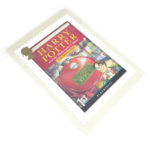
Harry Potter shows why these details matter. The first printing of Harry Potter and the Philosopher’s Stone (Bloomsbury, 1997) is one of the most sought-after modern first editions, and collectors look for tell-tale signs such as a full number line running down to 1, the author credited as “Joanne Rowling” on the copyright page, and a small error where “1 wand” appears twice in the list of school equipment.
Later books in the series had far larger print runs, but the same checks still separate a first printing from a reprint. See our Order of the Phoenix first edition, first printing and the rest of our J K Rowling collection.
What about signed and doodled first editions?
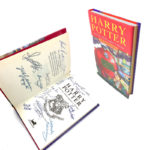
A signature makes a first edition more desirable, and a doodle makes it unique. Many of the books at Doodled Books were signed and drawn in by the authors and illustrators themselves, from Brian Williams’ Tunnels moles to Mark Zug’s illustrations in Angie Sage’s Septimus Heap books and Patrick Rothfuss’s pencil sketches in The Slow Regard of Silent Things.
When buying a signed copy, look for:
- Provenance. Where was it signed, and by whom? Buy from sellers who can tell you.
- Extras. A date, a line from the book (“lined”), a number or a doodle all add character and value.
- Clear photos. You should be able to see the actual signature and drawing in your copy, not a stock image.
Quick checklist
- Does the “First published” date match the book’s original release?
- Are there no “Reprinted” dates?
- Does the number line include a 1?
- Is it from the original publisher?
- For hardbacks: is the dust jacket from the same printing, with the price intact?
- If signed: can the seller show you the signature and explain where it came from?
If you can tick all of those, you’ve found a true first edition. Ready to start your collection? Browse our signed first edition books, many hand-doodled by the authors, with every copy photographed so you can see exactly what you’re buying.